
How to Read EXIF: ISO, Aperture, Shutter Speed & Focal Length Explained
Every photo you take is also a little lab report. Hidden inside the file, the camera wrote down exactly how it took the picture: how long the shutter stayed open, how wide the lens was, how much it amplified the signal. Learn to read those four numbers and you will understand why one shot is sharp and the next is blurry, why night photos look grainy, and what to change next time.
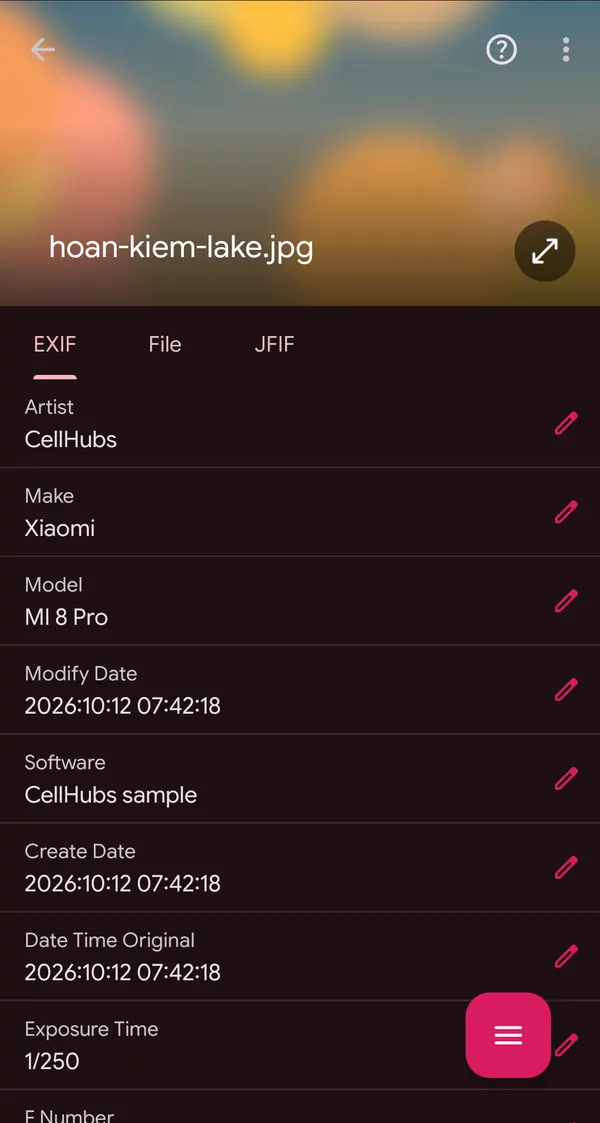
Open any photo in ExifTool and follow along.
The big four
1. Exposure Time (shutter speed): 1/250
How long the sensor collected light. Short times freeze motion, long times let in more light but blur anything that moves, including your hands.
| Exposure Time | What it’s good for |
|---|---|
| 1/1000 s and faster | sport, pets, kids running, splashing water |
| 1/250 s | everyday handheld, people walking |
| 1/60 to 1/30 s | indoor, still subjects; hold steady |
| 1/4 s and slower | night mode, tripod, light trails |
Blurry photo? Check this number first.
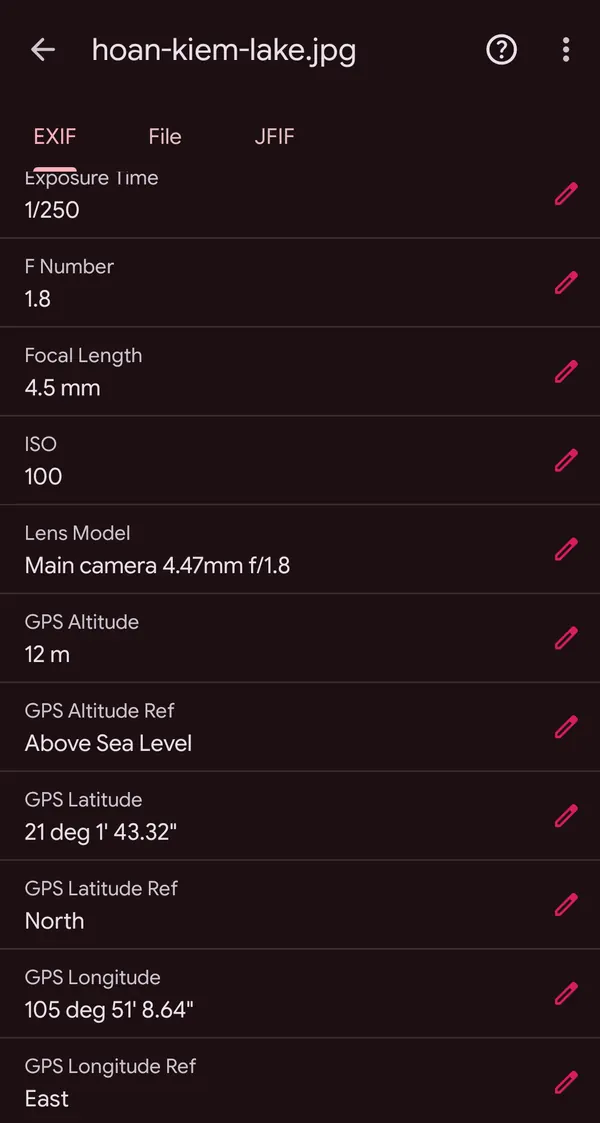
2. F Number (aperture): 1.8
How wide the lens opening was. A smaller number = wider opening = more light and a blurrier background. Phones usually have a fixed aperture per lens (often f/1.5 to f/2.4 on the main camera), which is why you’ll see the same value on every shot.
3. ISO: 100
How much the camera amplified the signal. Low ISO (50 to 200) means clean images in good light. High ISO (1600+) means the phone was struggling for light, and you’ll see grain and smudged detail. If your night photos look like watercolours, the EXIF will usually show a very high ISO.
4. Focal Length: 4.5 mm
How “zoomed” the lens is. On phones the real value is tiny because the sensor is tiny. Look for Focal Length In 35mm Format to compare with normal cameras: about 13 to 16 mm is ultra-wide, 24 to 28 mm is the main camera, 70 mm and above is telephoto.
Other tags worth knowing
- Make / Model / Lens Model: which phone and which of its cameras took the shot (main, ultra-wide, tele). Great for “which lens is sharper?” experiments.
- Date Time Original: when the shutter was pressed. Modify Date changes when the file is edited.
- Flash: whether it fired. White Balance: auto or manual.
- GPS Latitude / Longitude / Altitude: where you were. This is the one to remove before sharing.
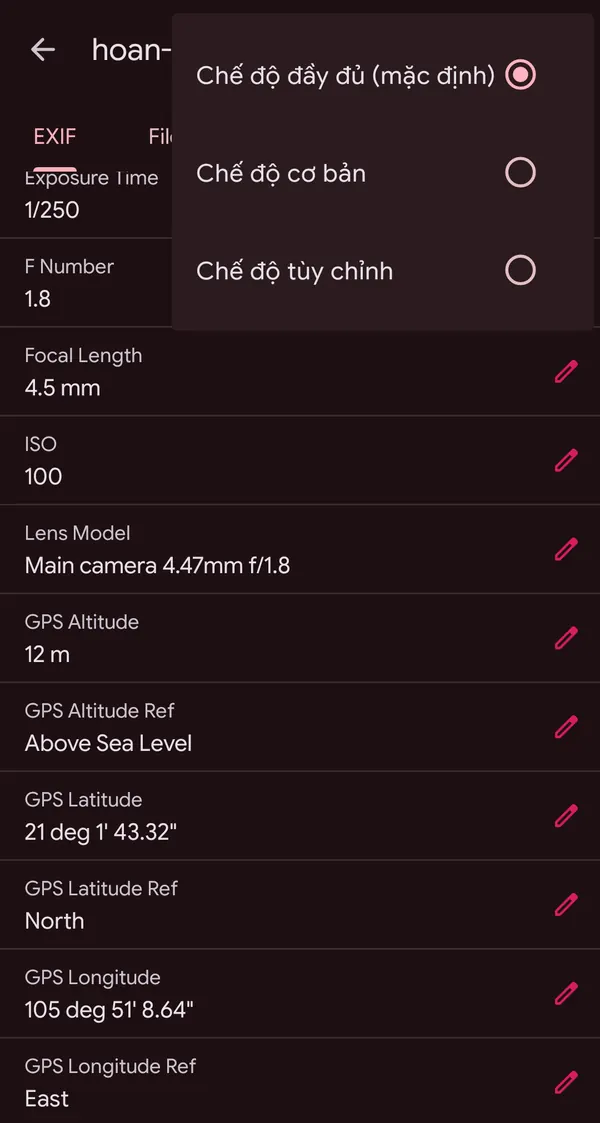
Too many tags? Switch to Basic mode from the three-dot menu.
Turn it into better photos: a 10-minute exercise
- Take the same scene three times: in daylight, indoors, at night.
- Open each one in ExifTool and write down Exposure Time and ISO.
- Notice the pattern: as light drops, the phone slows the shutter and raises ISO. That’s where blur and grain come from.
- Next time, brace your elbows, lean on a wall or switch to night mode, and compare the EXIF again.
Ten minutes of this teaches more than an hour of theory.
Show it off
Once you know the numbers, make them part of the picture: ExifTool can add a camera-info frame with focal length, f-number, shutter and ISO, the style photography accounts use.
More: what EXIF data is · every ExifTool feature
How to install ExifTool
- Android: Open Google Play, search for “ExifTool” or tap the Google Play badge below, then tap Install. Updates arrive automatically through Google Play.
- iPhone / iPad (beta): The iOS version is in beta on TestFlight. Install Apple’s TestFlight app from the App Store, then open the TestFlight link below on your iPhone and tap Accept → Install. If the beta is full, check back later.
Coming soon: App Store.
💡 Tip: only install ExifTool from the official stores or the links on this page, never from unknown APK/IPA mirrors. See every feature on the ExifTool page.
FAQ
Why is my phone's focal length so small, like 4.5 mm?
Phone sensors are tiny, so the real focal length is only a few millimetres. The Focal Length In 35mm Format tag (often 24 to 28 mm on a main camera) is the number to compare with traditional cameras.
Can I change the aperture on my phone?
Most phones have a fixed aperture, so the f-number is the same on every photo from that lens. The phone changes shutter speed and ISO instead. Portrait mode simulates a wider aperture with software.
Which EXIF value explains a blurry photo?
Look at Exposure Time. Anything slower than about 1/30 s handheld, or slower than 1/250 s for moving subjects, is a common cause of blur.
Do all photos have this information?
Photos straight from a camera or phone do. Screenshots, images saved from social networks and many messaging apps have most of it removed.